
Student Loan Default in 2026: Wage Garnishment, Credit Damage, and How U.S. Borrowers Can Legally Recover

Published July 13, 2026

Roughly 43 million Americans hold federal student loans, and after the end of the Fresh Start on-ramp protection period in October 2024, the U.S. Department of Education has resumed full collections activity against borrowers who fall behind. According to data published by the Federal Student Aid Data Center, more than 5 million federal borrowers were officially in default as of early 2026, and millions more sat in late-stage delinquency vulnerable to entering default within the next twelve months.
The consequences of default are not abstract. They include administrative wage garnishment without a court order, Treasury offset of federal tax refunds and Social Security benefits, a 90-point average drop in credit score reported by the Federal Reserve Bank of New York's Household Debt and Credit Report, and long-term barriers to mortgage approval, professional licensure, and federal employment.
This guide explains, in neutral and factual terms, how federal student loan default works in 2026, what legal rights borrowers retain under the Higher Education Act, and how consumer-protection attorneys, income-driven repayment plans, loan rehabilitation, and consolidation can each restore a borrower to good standing.
Table of Contents
- What Counts as Default in 2026
- The Federal Delinquency and Default Timeline
- Administrative Wage Garnishment: Rules, Limits, and Exceptions
- Treasury Offset, Tax Refunds, and Social Security
- Credit Reporting and the 90-Point Score Drop
- Borrower Rights Under the Higher Education Act
- Loan Rehabilitation Step by Step
- Direct Consolidation as an Exit Route
- Income-Driven Repayment After Default
- Discharge, Cancellation, and Bankruptcy in 2026
- When to Retain a Consumer-Rights Attorney
- Credit Insurance, Disability Coverage, and Loan Protection
- Frequently Asked Questions
What Counts as Default in 2026
For most federal Direct Loans and Federal Family Education Loans (FFEL) held by the Department of Education, default occurs after 270 days of missed payments. At day 271 the loan is transferred from the assigned servicer to the Department's Default Resolution Group, and collection costs of up to 24.03 percent of the outstanding principal and interest may be added under statutory authority granted by 34 CFR 685.202.
Perkins Loans, a smaller and now-discontinued program still held by many colleges, follow a different rule: default is declared after just 270 days of nonpayment on a monthly installment schedule, but with only nine months of consecutive missed payments the school may accelerate the full balance immediately. Private student loans, by contrast, are governed by the loan contract and state law, and default terms typically trigger after 90 to 120 days of missed payments.
Borrowers who entered repayment under the SAVE plan and were placed in administrative forbearance during the 2024 and 2025 court injunctions were not accruing days toward delinquency during that period. As clarified in guidance issued through StudentAid.gov, forbearance months do not count toward the 270-day default clock, but they also do not count toward Public Service Loan Forgiveness or Income-Driven Repayment forgiveness unless a specific credit provision applies.
The Federal Delinquency and Default Timeline
Understanding the timeline is essential because each stage carries a different set of legal remedies. The Department of Education's published schedule for a Direct Loan borrower in repayment status looks like this:
| Day | Status | Consequences |
|---|---|---|
| 1–29 | Late but not delinquent | Late fee may accrue per promissory note |
| 30–89 | Delinquent | Servicer outreach; no credit report impact |
| 90–270 | Reported delinquent | Reported to national credit bureaus |
| 271 | Default | Loan sent to Default Resolution Group; collection fees added |
| +425 | Treasury Offset eligible | Tax refunds and federal benefits can be seized |
| +425 | AWG eligible | Up to 15% of disposable wages garnished without court order |
Borrowers who enrolled in the Fresh Start initiative before its September 30, 2024 deadline had their default status removed from credit reports and were restored to current status, but Fresh Start is no longer accepting new enrollments. Borrowers who defaulted after Fresh Start ended must rely on rehabilitation, consolidation, or full repayment to exit default.
Administrative Wage Garnishment: Rules, Limits, and Exceptions
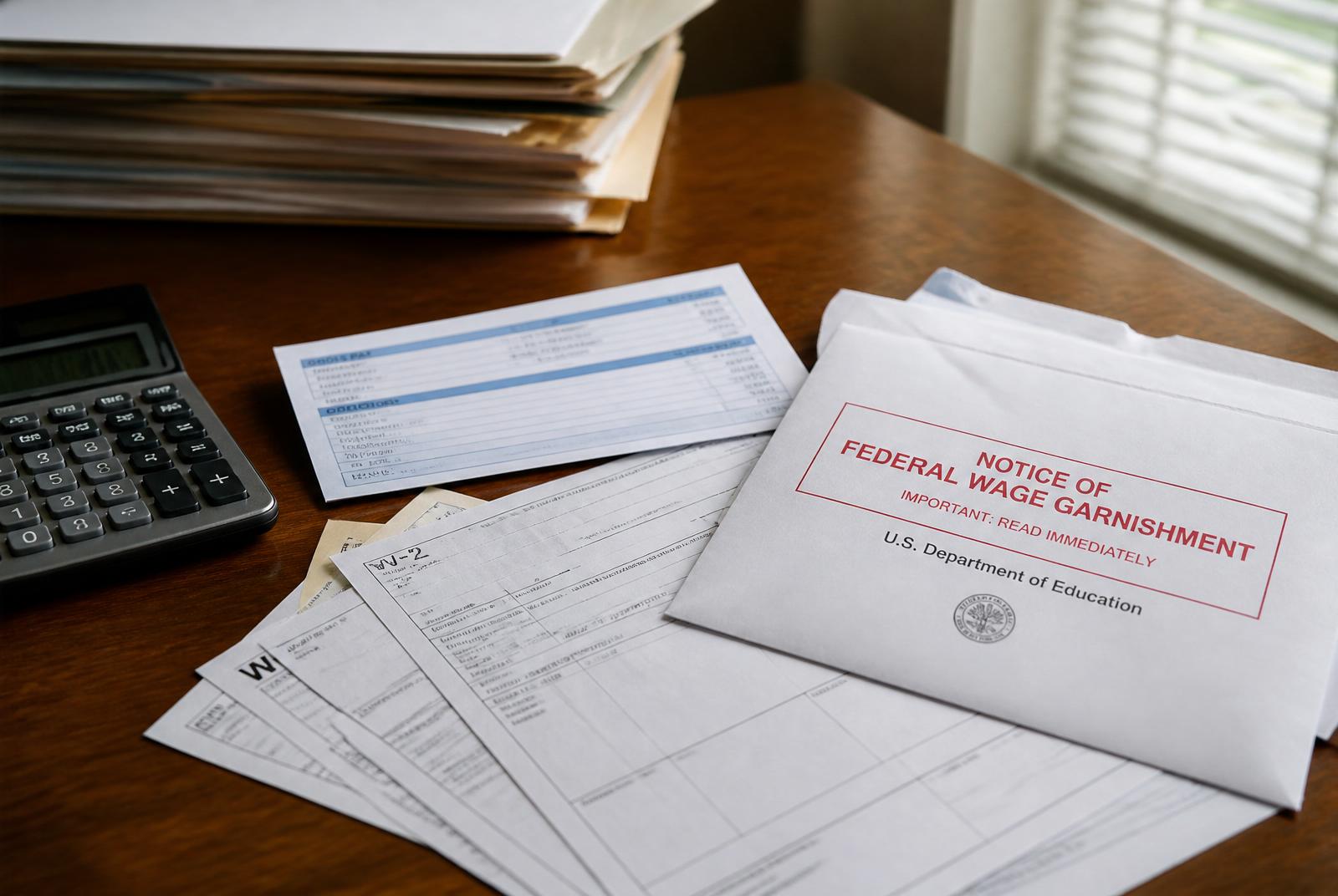
Administrative Wage Garnishment (AWG) is one of the most powerful collection tools available to the federal government. Under the Higher Education Act, the Department of Education may issue a garnishment order directly to a borrower's employer without first suing the borrower or obtaining a court judgment. The order requires the employer to withhold up to 15 percent of the borrower's disposable pay, which is defined as gross earnings minus legally required deductions such as federal, state, and local taxes and mandatory retirement contributions.
Before garnishment begins, the Department must send a written 30-day notice by mail to the borrower's last known address. The notice must state the total amount owed, the intent to garnish, and the borrower's right to request a hearing. The hearing may be conducted by phone, in person, or on the written record.
Grounds to Challenge a Garnishment Order
- The debt is not owed or the amount is incorrect.
- Garnishment would create financial hardship, defined by regulation as inability to meet essential household expenses such as housing, food, medical care, and transportation to work.
- The borrower has been employed in the current job for fewer than 12 consecutive months after an involuntary separation from prior employment.
- The borrower is currently in an approved repayment plan or rehabilitation agreement.
Federal law also protects a floor of income: no garnishment may reduce a borrower's weekly disposable pay below 30 times the federal minimum wage. In 2026 that floor equals $217.50 per week, as detailed in the U.S. Department of Labor Wage and Hour Division guidance.
Treasury Offset, Tax Refunds, and Social Security
The Treasury Offset Program, administered by the U.S. Department of the Treasury's Bureau of the Fiscal Service, allows federal agencies to intercept payments owed to a taxpayer to satisfy delinquent federal debts. For defaulted student loan borrowers, this most commonly means the seizure of federal income tax refunds, including refundable portions of the Earned Income Tax Credit and the Child Tax Credit.
Social Security retirement and disability benefits are also subject to offset, though with statutory protections. The first $750 per month of Social Security benefits is exempt, and no more than 15 percent of the total monthly benefit above that floor may be withheld. Supplemental Security Income (SSI) is entirely exempt from offset.
Reversing an Offset
Borrowers who receive a Notice of Offset from the Treasury have 65 days to request review. Successful challenges typically demonstrate one of the following: the underlying loan was discharged, the borrower is not the person who owes the debt, the borrower has entered a repayment agreement before the offset occurred, or the borrower faces documented financial hardship such as pending eviction or utility shutoff.
Credit Reporting and the 90-Point Score Drop
Credit consequences begin long before default. Once a payment is 90 days past due, the servicer reports the delinquency to Equifax, Experian, and TransUnion. By day 270 the loan is coded as in default, and it will remain on the borrower's credit report for seven years from the date the account first went delinquent, per the Fair Credit Reporting Act.
The New York Fed's 2025 analysis of the resumption of default reporting found that borrowers whose loans transitioned to default status experienced an average FICO score decline of 90 points, with borrowers who previously carried strong credit (scores above 720) losing an average of 129 points. That severity is driven by the fact that a defaulted student loan is treated as a serious derogatory event on par with a foreclosure or a Chapter 7 bankruptcy in the scoring models used by FICO 8 and VantageScore 4.0.
Borrower Rights Under the Higher Education Act
The Higher Education Act of 1965, as amended through the 2024 negotiated rulemaking cycle, guarantees defaulted borrowers a defined set of statutory rights that cannot be waived, altered, or narrowed by a servicer or collection agency. The most important are summarized below.
Right to Written Notice
Before garnishment, offset, or any adverse credit reporting continues, the borrower must receive written notice explaining the debt, the intended action, and the process for challenge.
Right to a Hearing
Any borrower subject to AWG may request a hearing before garnishment begins. If the request is made within 30 days of the notice, garnishment must be delayed until the hearing decision is issued.
Right to Rehabilitate Once
Every federal Direct Loan borrower is entitled to one loan rehabilitation per loan. After rehabilitation is complete, the default is removed from the credit report and the borrower regains eligibility for federal student aid, income-driven repayment, and forbearance.
Right to Reasonable and Affordable Payment
During rehabilitation, monthly payments must be set at an amount the Department determines is "reasonable and affordable" based on the borrower's total financial circumstances, not simply a percentage of the loan balance.
Right to Discharge in Defined Circumstances
Federal loans may be discharged in full or in part upon proof of total and permanent disability, death, school closure, false certification, borrower defense to repayment, or unpaid refund from the school. Each program has distinct evidentiary rules governed by the Higher Education Act and 34 CFR Parts 674, 682, and 685.
Loan Rehabilitation Step by Step
Loan rehabilitation is a one-time opportunity to cure default on a Direct Loan or FFEL Loan by making nine voluntary, on-time, full monthly payments within a ten-consecutive-month window. After the ninth qualifying payment posts, the loan is sold back to a servicer, the default notation is removed from the borrower's credit report, and the borrower regains full federal aid eligibility.
The Rehabilitation Payment Calculation
The Department calculates the rehabilitation payment using 15 percent of the borrower's discretionary income divided by twelve. Discretionary income is defined as adjusted gross income (AGI) minus 150 percent of the federal poverty guideline for the borrower's family size and state. For borrowers with very low income, the minimum rehabilitation payment is $5 per month. Documentation of income, typically through the most recent federal tax return or pay stubs, is required.
What Rehabilitation Does Not Do
- It does not eliminate the collection costs already added to the balance, though it caps those costs at 16 percent of principal and interest, down from the 24.03 percent maximum otherwise assessed.
- It does not remove late-payment history from before the default.
- It does not restart the seven-year clock for delinquency reporting.
- It cannot be used a second time on the same loan.
Direct Consolidation as an Exit Route
For borrowers who need immediate resolution of default (for example, to become eligible for federal aid for the next semester or to stop an imminent garnishment), Direct Consolidation offers a faster exit than rehabilitation. Consolidation combines one or more defaulted federal loans into a single new Direct Consolidation Loan, and the new loan is not in default from day one.
To consolidate a defaulted loan, the borrower must either agree to repay the new consolidation loan under an income-driven repayment (IDR) plan or make three consecutive, on-time, full monthly payments on the defaulted loan before consolidation. The IDR route is faster and typically results in a lower monthly obligation.
The trade-off is that consolidation does not remove the default notation from the credit report. The old defaulted loan is closed and shows as paid through consolidation, but the historical default remains visible for the full seven-year retention period.

Income-Driven Repayment After Default
Once a borrower exits default through rehabilitation or consolidation, four income-driven repayment plans are available in 2026, each governed by different regulatory provisions:
| Plan | Payment Formula | Forgiveness Horizon |
|---|---|---|
| SAVE (pending litigation) | 5%–10% of discretionary income above 225% FPL | 10–25 years, based on original balance |
| PAYE | 10% of discretionary income above 150% FPL | 20 years |
| IBR (post-2014) | 10% of discretionary income above 150% FPL | 20 years |
| IBR (pre-2014) | 15% of discretionary income above 150% FPL | 25 years |
The SAVE plan remains subject to ongoing federal litigation as of 2026, and enrollment status varies. Borrowers should confirm current plan availability directly through the Federal Student Aid portal before selecting a plan.
Discharge, Cancellation, and Bankruptcy in 2026
Federal student loans have historically been extraordinarily difficult to discharge in bankruptcy, but the 2022 joint guidance issued by the U.S. Department of Justice and the Department of Education created a streamlined attestation process for borrowers seeking discharge under the "undue hardship" standard of 11 U.S.C. § 523(a)(8). Under the guidance, borrowers who complete the attestation form and demonstrate present inability to pay, future inability to pay, and good-faith prior efforts to repay are entitled to a Justice Department recommendation of discharge.
Reported outcomes since implementation, tracked by the Consumer Financial Protection Bureau, show a significant increase in adversary-proceeding discharges compared with the prior period, though bankruptcy discharge remains rare relative to the total borrower population.
Non-bankruptcy discharges include total and permanent disability discharge (administered jointly with the Social Security Administration and Veterans Affairs), closed school discharge for borrowers whose institution closed while they were enrolled or within a defined window after withdrawal, false certification discharge, and borrower defense to repayment for borrowers whose school engaged in substantial misrepresentation.
When to Retain a Consumer-Rights Attorney
Not every defaulted borrower needs an attorney, but several situations warrant legal counsel from a consumer-protection lawyer, a legal aid society, or a nonprofit such as the National Consumer Law Center's Student Loan Borrower Assistance project.
- The borrower has been sued by a private lender or a debt buyer on a defaulted private loan.
- The borrower has received notice of AWG and believes the underlying debt is disputed, the amount is incorrect, or garnishment would cause financial hardship.
- The borrower's Social Security benefits are being offset in excess of statutory limits.
- The borrower is considering bankruptcy discharge and needs help preparing the attestation form and adversary complaint.
- The borrower's application for borrower defense, closed school discharge, or total and permanent disability discharge has been denied.
- The borrower is subject to a state-court judgment on a private student loan and needs post-judgment garnishment or wage-exemption defense.
Related reading on the Trust All America blog covers refinancing education loans for lower rates, comparing loan providers and options, and the current state of PSLF and SAVE forgiveness in 2026.
Credit Insurance, Disability Coverage, and Loan Protection
Federal student loans are automatically discharged upon the death of the borrower or a total and permanent disability determination, without the need for a separate insurance product. This built-in protection makes private credit-life insurance sold in conjunction with federal loans generally unnecessary and, in most states, prohibited from bundling.
Private student loans are different. A private loan does not automatically discharge on death or disability unless the promissory note explicitly says so. Borrowers with substantial private loan balances should confirm the contractual death and disability terms and, where the loan is silent, consider a term-life policy with a face value at least equal to the outstanding balance. Long-term disability insurance from a group employer plan or an individual policy can provide income replacement that keeps loan payments current during a qualifying disability, avoiding the delinquency-to-default pipeline.
For an overview of how personal insurance interacts with major financial obligations, see the general guide to personal insurance planning in the United States.
Frequently Asked Questions
How long does it take to exit default through rehabilitation?
Rehabilitation requires nine on-time monthly payments completed within a ten-month window. Most borrowers exit default nine to ten months after the first qualifying payment posts.
Can the Department of Education garnish my wages without going to court?
Yes. Under the Higher Education Act, administrative wage garnishment does not require a court judgment. The Department must send written notice and afford the borrower the right to request a hearing before garnishment begins, but no lawsuit is required.
How much of my paycheck can be garnished for a federal student loan?
Up to 15 percent of disposable pay, subject to the floor that weekly disposable pay may not be reduced below 30 times the federal minimum wage ($217.50 per week in 2026).
Will loan rehabilitation remove the default from my credit report?
Yes. Completion of rehabilitation removes the default notation. Individual late-payment records from before the default remain on the credit report for seven years from the date of the delinquency.
Can Social Security benefits be seized for a defaulted student loan?
Yes, but only Social Security retirement and disability benefits above $750 per month are subject to offset, and the offset is capped at 15 percent. Supplemental Security Income (SSI) is fully exempt.
Are private student loans subject to the same 270-day default rule?
No. Private student loans typically enter default after 90 to 120 days, but the exact terms depend on the loan contract and state law. Private lenders must obtain a court judgment before garnishing wages.
Can I still qualify for a mortgage while in default?
FHA, VA, USDA, and most conventional mortgage programs treat a federal student loan default as a disqualifying event under the federal Credit Alert Verification Reporting System (CAIVRS). Borrowers generally must first cure the default, typically through rehabilitation, before mortgage approval is possible.
Does bankruptcy still require an adversary proceeding for student loans?
Yes. Discharge under 11 U.S.C. § 523(a)(8) requires an adversary proceeding within the bankruptcy case, but the 2022 Department of Justice guidance has streamlined that process by providing a standardized attestation form and a clearer path to a government non-opposition or recommendation of discharge in qualifying cases.
Disclaimer: This article is provided for general informational purposes only and does not constitute legal, financial, or tax advice. Federal student loan regulations change frequently, and case-specific outcomes depend on individual circumstances. Readers facing default, garnishment, or an active collection action should consult a licensed attorney, a HUD-approved housing counselor, or an accredited nonprofit credit counselor before making decisions. Source figures are drawn from the U.S. Department of Education, the Federal Reserve Bank of New York, the U.S. Department of Labor, and the Consumer Financial Protection Bureau as of publication and are subject to update.
Related Articles

Medicare Advantage Denials in 2026: How to Appeal Prior Authorization Rejections and Protect Your Coverage
A neutral, source-based 2026 guide to Medicare Advantage denials: prior authorization rules, the five-level appeal process, expedited review, new CMS coverage rules, and when to hire an elder-law attorney.

FAFSA 2026-2027: Student Aid Index, Pell Grant Expansion, and How to File for Maximum Aid
A neutral 2026-2027 FAFSA guide covering the new Student Aid Index, expanded Pell Grant eligibility, the contributor model, required documents, and step-by-step filing procedures.

Wrongful Termination in 2026: How U.S. Employees Prove Retaliation and Recover Damages
A neutral, source-based 2026 guide to wrongful-termination law in the United States: at-will exceptions, retaliation claims, EEOC filing procedure, damages, and how employment-practices insurance shapes settlements.

Mental Health Parity in 2026: How to Fight Insurance Denials for Therapy and Rehab
A neutral, source-based 2026 guide to the Mental Health Parity and Addiction Equity Act, the 2024 final rule, and the appeal and litigation options available when a health plan denies coverage for therapy, medication, or residential treatment.